The Forge Initiative
- by OCF
The Boy Who Wanted to Sew, but Had No Machine
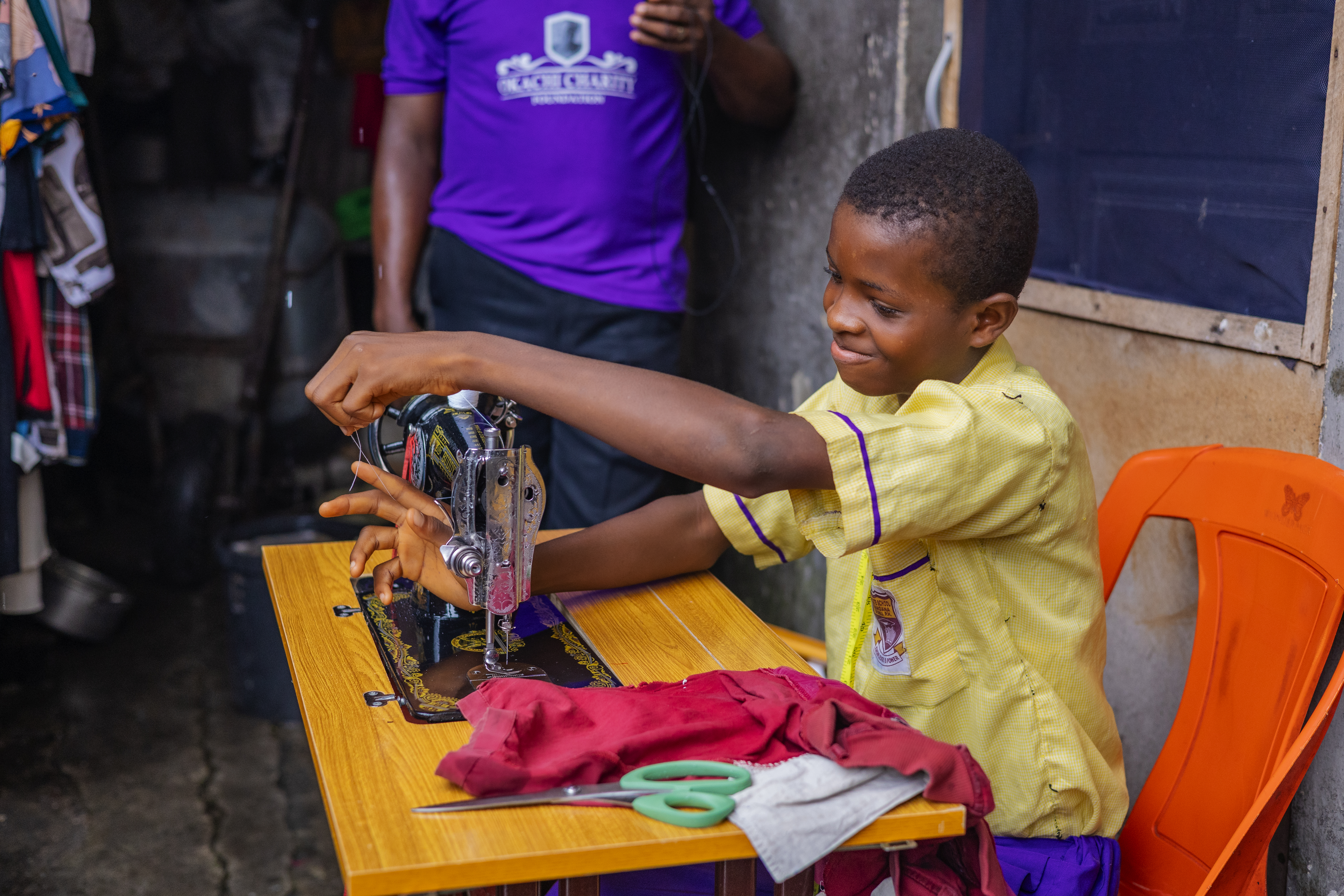
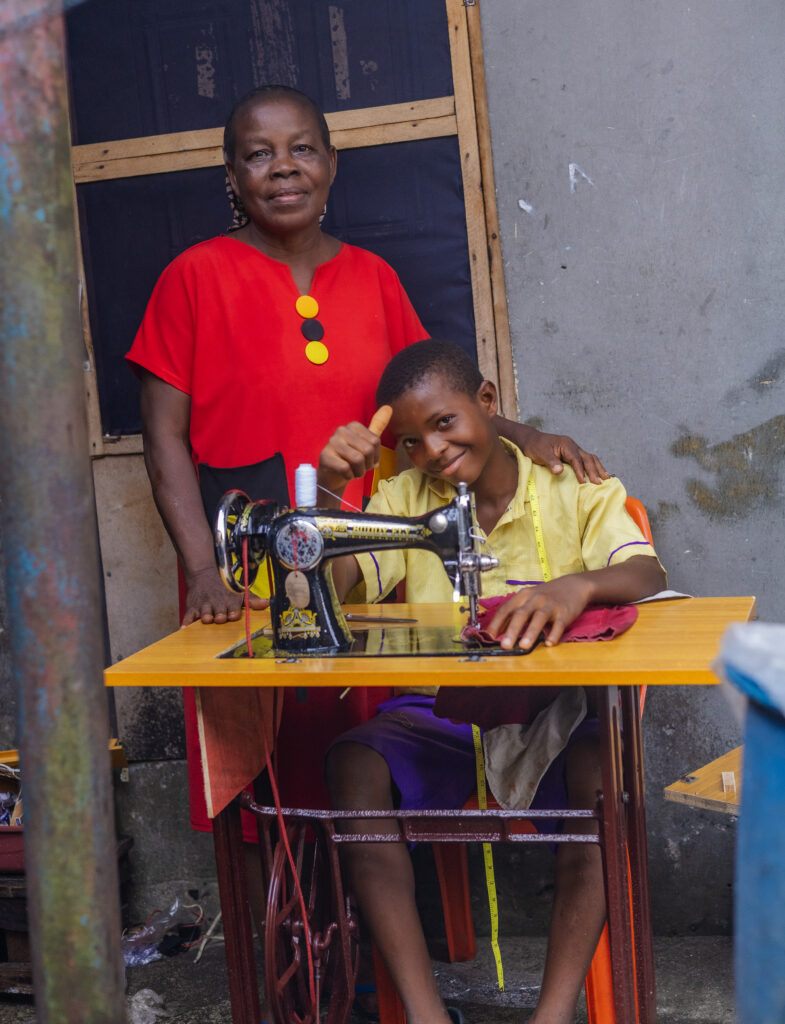
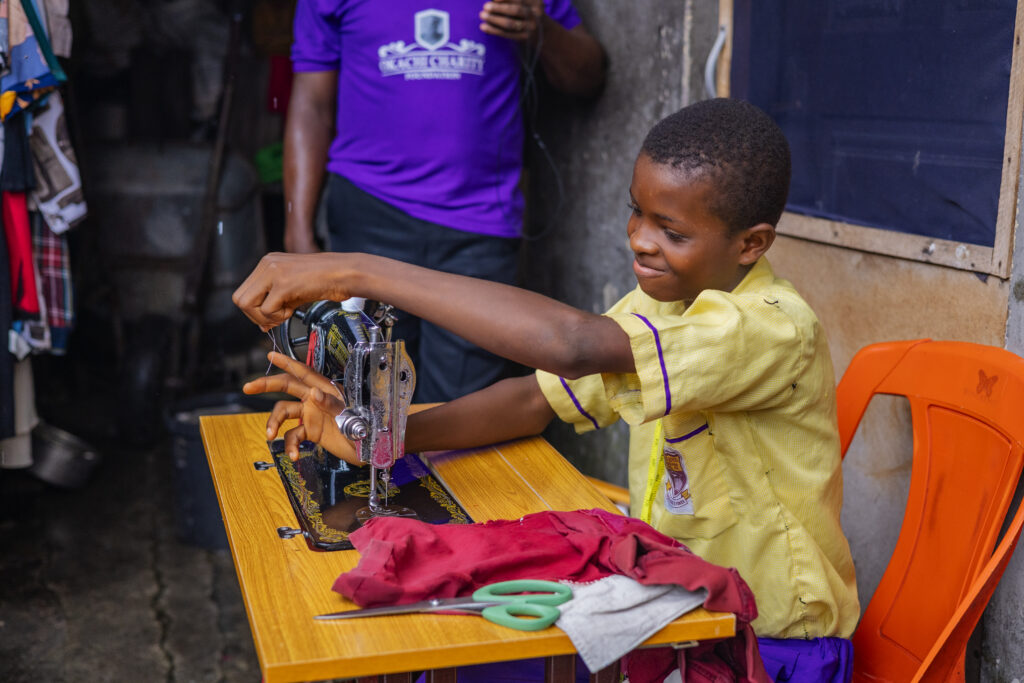
Featured Child: Tochukwu Chukwuemeka
Some children demonstrate intelligence through examination results.
Others reveal their abilities through the questions they ask, the objects they repair, and the things they attempt to make.
Tochukwu Chukwuemeka belongs to the latter group.
His story challenges a narrow understanding of academic ability and demonstrates why practical skill development deserves serious investment.
TOCHUKWU CHUKWUEMEKA
The Boy Who Wanted to Sew, but Had No Machine
A Talent Discovered Through His Hands
During OCF’s educational and summer-school engagement, Tochukwu demonstrated a strong interest in practical activities.
He was drawn to tailoring, repairing clothing, and working with household items.
He showed initiative in fixing and modifying things around him, including clothing and everyday belongings.
This was not simply an interest introduced by an adult.
He was already experimenting, observing, and attempting to create solutions through his own efforts.
His interest suggested practical intelligence, curiosity, patience, and the desire to develop a useful skill.
But the path from interest to competence is rarely straightforward.
When His Parents Tried to Support His Talent
At first, Tochukwu’s interest in sewing was not an obvious educational direction for his family.
As the seriousness of his interest became clearer, his parents supported his desire to learn and enrolled him in sewing or fashion-design training.
That decision mattered.
It represented an effort to respond to what their child was demonstrating rather than dismissing an unconventional interest.
But training introduced a practical problem.
Tochukwu needed equipment to practise and complete his assignments.
He did not have a sewing machine of his own.
Without consistent access to one, he struggled to complete the work required by the training program.
Eventually, his participation in the training was interrupted.
Here was a child with interest, ability, and parents willing to support his development.
Yet a missing piece of equipment stood between him and further learning.
For OCF, that detail was impossible to ignore.
The Cost of a Missing Tool
A sewing machine might appear modest when compared with the cost of building a school or funding a major education program.
But to a child learning tailoring, it is not a luxury.
It is a learning tool.
Without it, practice becomes irregular. Assignments may become difficult to complete. Skills can develop more slowly, and the encouragement that comes with visible progress may diminish.
For parents, finding the money for specialized equipment can be difficult, particularly when the household must also meet ordinary educational and living expenses.
Families can encourage a child’s ambition but still lack the financial capacity to provide everything required to pursue it.
Tochukwu’s experience exposed a gap between identifying talent and equipping a child to develop it.
It also provided an important lesson in educational intervention.
Mathematics has applications in measurement, pattern design, costing, and production.
Reading and communication are important for understanding instructions, interacting with customers, and explaining ideas.
Creativity, problem-solving, organization, and financial literacy all have meaningful roles in developing practical competence.
A child’s interest in tailoring can therefore become a starting point for learning across several disciplines.
What This Means for His Parents
For Tochukwu’s parents, the intervention is designed to address two related responsibilities.
The first is the cost of supporting a child’s practical interest.
The second is the continuing financial responsibility associated with formal schooling.
Under the scholarship arrangement outlined in his selection letter, OCF committed to taking responsibility for school-related financial obligations and coordinating payments directly.
This structure is intended to reduce the burden of those costs while providing a clearer system of accountability.
The equipment and mentorship commitments address the additional resources Tochukwu needs to develop his talent.
Together, these forms of support could reduce the pressure on his family to choose between ordinary educational expenses and specialized skill development.
They could also give his parents greater confidence that his interest in tailoring is being developed within a supervised educational framework.
Actual equipment delivery, expenditure, and scholarship disbursements must be confirmed in subsequent monitoring records.
A Future Beyond the Sewing Machine
It would be easy to describe Tochukwu’s future simply as becoming a tailor.
But doing so would place unnecessary limits on a child whose abilities are still developing.
He may eventually pursue fashion design, garment production, technical craftsmanship, entrepreneurship, or an entirely different profession.
He may also decide that sewing remains a useful personal skill rather than his principal career.
All these possibilities are legitimate.
The purpose of The Forge Initiative is not to decide his future for him.
It is to ensure that a lack of basic resources does not prematurely decide that future on his behalf.
A sewing machine can provide a means of practice, experimentation, and gradual improvement.
Under appropriate training and mentorship, those experiences can help a child develop independence, resilience, technical confidence, and practical competence.
Why Tochukwu’s Story Matters Beyond One Family
Nigeria’s educational future requires more than university graduates.
The country also needs technically capable young people, skilled craftspeople, innovators, engineers, designers, and entrepreneurs.
Practical education should not be viewed as an inferior alternative to academic learning.
Children learn and express intelligence in different ways.
Some excel at mathematics. Others demonstrate extraordinary spatial understanding, mechanical curiosity, creativity, or the ability to make and repair objects.
A responsive educational system creates opportunities for all these abilities to develop.
The Forge Initiative represents OCF’s effort to contribute to that broader understanding of education.
Tochukwu was not selected because he had already mastered a profession.
He was selected because he had demonstrated the interest, initiative, and willingness to learn.
His story reminds us that a child’s potential can be interrupted by something as ordinary as the absence of a tool.
THE PEOPLE BEHIND THE PROGRAMS
Why Supporting a Child Also Matters to a Family
Every educational intervention reaches beyond the individual child.
Behind each student is a household making decisions about education, finances, time, opportunity, and the future.
Parents may provide encouragement, make sacrifices, seek opportunities, and invest what resources they can.
But encouragement alone cannot pay school expenses or supply specialized equipment.
This is why OCF’s three initiatives consider both the individual child and the surrounding family environment.
For Treasure and ThankGod, the Legacy Bridge Program is intended to reduce barriers to educational continuity at a particularly important transition.
For Deborah, the Ascend Scholars Initiative recognizes the importance of supporting a capable child without assuming that one opportunity within a family is sufficient.
For Tochukwu, The Forge Initiative seeks to remove specific financial and practical obstacles affecting both skill development and formal education.
The anticipated benefits reach beyond school fees or equipment.
Reliable assistance can help parents plan with greater certainty.
It can reduce the immediate financial pressure associated with educational expenses.
It can also strengthen a family’s ability to support a child’s interests without placing every responsibility on household resources.
These benefits must be measured through family interviews, payment records, and follow-up assessments rather than assumed.
Nevertheless, they form an important part of the foundation’s program design.
Educational support is most meaningful when it responds to the actual circumstances of children and the people responsible for raising them.
WHAT THE EARLY EVIDENCE TELLS US
Measuring More Than the Number of Children Selected
Across these three initiatives, OCF has identified four children whose stories demonstrate different educational needs and abilities.
Portfolio at a Glance
3 targeted educational initiatives
The Legacy Bridge Program, Ascend Scholars Initiative, and The Forge Initiative.
4 children profiled
Treasure Lebeteh Pya-Bari, ThankGod Isaac James, Deborah Pya-Bari, and Tochukwu Chukwuemeka.
2 former student leaders
Treasure, former Head Girl, and ThankGod, former Head Boy of Port Harcourt Primary School.
1 documented academic position
ThankGod’s most recently reported result places him second among 66 students at his secondary school, pending school-record verification.
1 inaugural practical-skills beneficiary
Tochukwu, selected for sewing equipment, mentorship, monitoring, and formal educational scholarship support.
2 sisters recognized through separate initiatives
Treasure under the Legacy Bridge Program and Deborah under Ascend Scholars.
2 years of engagement in Treasure’s selection story
From OCF’s first encounter with her in 2024 to her formal selection in April 2026.
What These Indicators Mean
These figures are early evidence of beneficiary identification, educational progress, and structured support commitments.
They are not yet a complete measure of long-term impact.
For OCF, the next stage of reporting must establish what assistance has actually been delivered and what changes have followed.
For the Legacy Bridge Program, relevant measures include successful secondary-school transition, attendance, academic performance, retention, leadership development, and financial support received.
For the Ascend Scholars Initiative, they include academic progression, individualized learning needs, mentorship participation, and sustained school engagement.
For The Forge Initiative, they include equipment delivery, training participation, completed practical assignments, school attendance, scholarship payments, and demonstrable skill improvement.
Regular monitoring will allow OCF to distinguish between promising outcomes and changes that can reasonably be associated with its interventions.
That distinction is essential to building credibility and understanding which elements of the programs should be expanded.